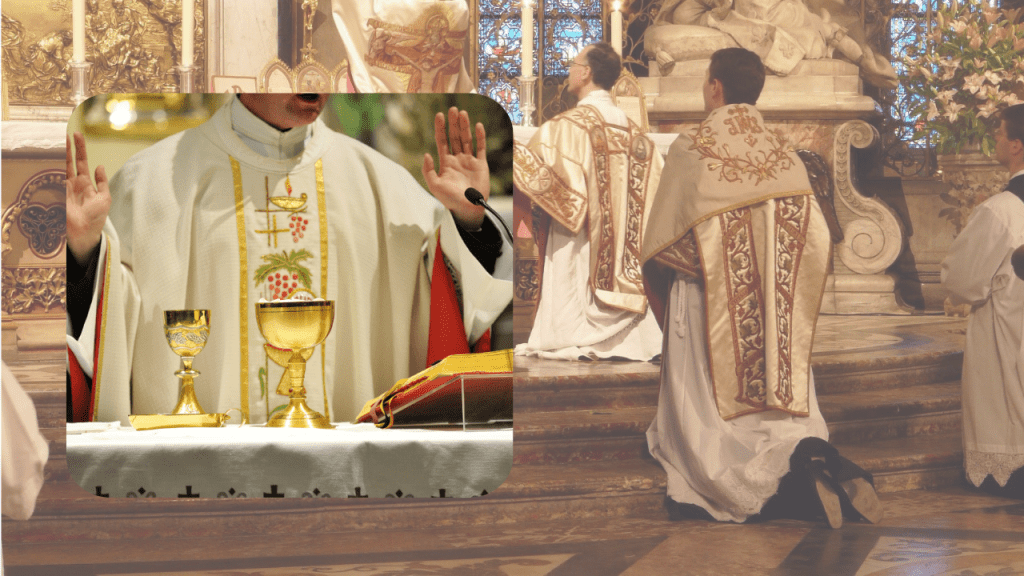
I’m not interested. But what am I not interested in, may the reader wonder as he reads the headline. Well, I’m not interested in traditional Catholicism. To begin with, I do not attempt to copy the long and often fallacy-filled complaints of certain blogs that attempt to pass as legitimate journalism in the world of religion. However, some generalization approaches will occur. I will also state that I strongly believe that the lack of ability to access the Latin Mass among many desiring Roman Catholic communities is something to sadden all of us. But, in the same tone, I’ll frankly state this: I’m just not interested in traditional Catholicism.
Having reconnected with my faith in my mid-teens, I began to swing into the typical framework mindset that’s nowadays often found on the internet among many young males in Catholicism: Augustine & Aquinas were my foundations [or so we would say as we watch endless videos of online apologists attempting to present these two giants of Western Christianity]. I came to believe in the same role of the beauty of the Latin Mass, which I began to attend. I also became wrapped into the belief that, in my case, American conservatism went hand in hand with traditional Catholicism and that I could only adhere loudly to traditional Catholicism and conservatism without caring if others became offended. The conflicted mythology became reflected in the belief that I am ashamed to admit sometimes would be prejudiced against people of marginalized communities. Even the dreams of a proper monarchy and/or integralist society shaped by my then-narrow understanding of Christianity and politics. Of course, I could not know any better than the traditional communities shaped and echoing similar or the same voices as mine.
First, I do want to admit that I am of the opinion that the New Mass, in itself, has failed. The social experimentation has led us to see something in which worship has become, in reality, so minuscule and mundane, with some homilies that make me wonder if the clergy ever took a single theology class. Of course, the traditionalist decision to blame Vatican II and the New Mass alone is rather simplistic. The real issues of the ongoing problems in worship and lack of beauty are, in essence, taking root in two dual points:
- The centralization of liturgy in Trent, which ultimately killed the organic development of communities into which apostolic Christianity was shaped and made
- The centralization of the papacy as a result of political environments and cultures. Something that, unfortunately, has been elevated in the thinking of some traditional and some neoconservative communities when it is convenient to call for ultramonatism.
The criticism of the centralization of worship and making worship more relevant to the current culture is not necessarily wrong. After all, liturgies developed from the worship of local pagan cultures, combining elements of Judaism. Of course, within organic elements, the idea of borrowing and incorporating them into the inner life of ritual worship and prayer is not uncommon. However, it is somewhat controversial for some to hear, unfortunately, due to the fact that most people interested in faith are mostly interested in apologetics and not theology or history proper.
Liturgy is important, and we should not ignore how poorly the introduction of the New Mass in the Latin rite has been executed. Nor should we ignore the reality that the New Mass is often celebrated in such a way that it focuses on the emotional aspects of the people, creating a horrible experience. Institutional figures often attempt to gaslight those who disagree with the reforms or even raise concerns about them. In the same way that traditional Catholicism does not interest me, the New Mass is something in which I have no interest. To me, it appears to be just a poorly done function, a relaunching of an old show while messing up key elements of the plot.
Overall, in the world of opinion, the most important aspects of Christianity, in order to shape an understanding of the Bible, is that of the Christians in the first four centuries. In such, I find the theology of the Communio theologians more practical and important. I take note that the importance of the resourcement theology birthed within the 19th-century world of the Orthodox church is a better approach than anything produced in all of the previous millennium. It is then that I find myself in echo of the proper worship and proper theology, which traditional Catholicism for me isn’t the approach. In the same place, neither is the New Mass and the world of it. I am not interested in long apologetics for authority trying to set me into a narrow reconstruction of Christian history so I can just be quiet and suffer in a bad liturgy because “Mother Rome says so.” Nor am I interested in the dichotomy in which Rome is important but not when I don’t want to agree with it. Both worlds of the New Mass and traditional Catholicism can brew such unhealthy attitudes.
 Nova Polis