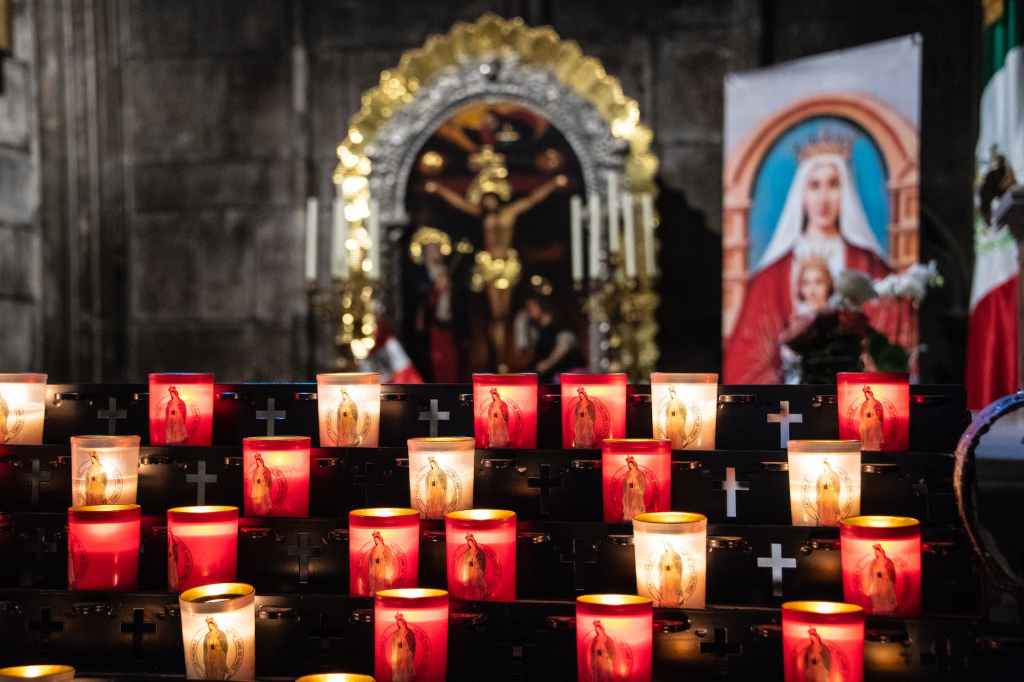
When speaking of religion, we often encounter the fellows that see the world in black and white. That is to say, a world of heresy vs. dogma. Often, to be honest with all of you, we are (or were) those fellows. I once was the young fellow with an obsessed love towards the notion of traditionalism. The traditional liturgy (of the Latin rite), a few key medieval saints, and a reading of the Bible not echoing the church, but what others with my idealism said. We turned tradition into an idol of worship and counter-cultural politics. Rather than a true and authentic esoteric tradition that guides us closer to God. FUNDAMENTALISM is this false narrative that tells us that the path towards God is one of dichotomy, rather than a deeply and complicated story of romance in which the lover discovers a story of the beholder.
The story of faith is truly one of romance. We learn to seek the beholder. First, we must encounter our Love-the Divine. Then, we ought to wrestle naked with His reality until the date of which we become one body within Him. The romance of each individual with the divine will be different. The divine is reflected as a mother, a father, a lover, nature, and more. All forms of love which we encounter into the realm of the observable is ultimately a reflection of the true love found alone within the Divine. This love which we encounter is, in a sense, a sexual love of eros (of course, it does not remain in eros, for it will continue toward in philia, ultimately culminating in agape). Not because there is a literal intercourse with God, that would indeed be not an appropriate sense in which I would use the explanation. But, it is sexual in its inner nature. We must become naked and vulnerable in order to encounter God. We must trust that when there is no light, and we are blinded by the night, that God’s arms, breathe, and body will be there not to hurt us but to embrace us. It is only when we become open to the embracing of God that we can encounter an inner dimension of ourselves. It shouldn’t amaze us that similar languages have been used by the spiritual masters of the world. Maximus the Confessor speaks of a creation that is Christocentric. Not only does Maximus draw a parallel between the story of the incarnation of the Logos of John 1 with that of creation of Genesis 1. He narrates that creation occurs through the logos. The natural world takes its shape through Christ. But, this was not enough for Maximus. For him, salvation is only within Christ. The nature of Christ is acquired by humans, in which we we experience an enhypostasis.
Yet, all of this runs the danger of fundamentalism. A false reading of the inner narrative of salvation by the stories of politics painted within religious traditions. Not alone does the churches of Christianity experience this difficulty. All religious and spiritual traditions run with the danger of being usurped by political narratives painted with a very light and transparent paint of authentic religious tradition. The problem is not alone that the reality of such dogmas and doctrines was painted once with such brushes. But, that the political narrative its often defended with fervor by theologians, apologists, and Theo-bros (online younger guys who believe that they can be authoritative on their speaking of anything) without parameters. The reality is that if we are unable to see the caveats of our religious traditions in which politics, cultures, and stories of fantasy shape them and constructed them. We are in danger of sacrificing the real-inner mystery of faith. In such, we should be able to acknowledge a sense of infallibility while admitting that nothing is infallible without caveats. We must be aware of the limits and shapes that formed and form our churches and religions. By doing so, we do not run the danger of having a tradition buried in a pothole of past politics and controversies. Religions that are stacked in the past not in an authentic preservation of history but rather in the fighting against the beauty of development due to inner pride are destined to become dead religions. This is because they are afraid of a development. They call these development as modernism, academia, and heresy. They assign such names to developments not after spending years nor even months of studying a subject in depth from all angles but after seconds of inner preconceived bias. False tradition is not the inner revelation of the divine mystery, but the set political idealism upon which they subscribe simply brushed with a fresh coat of “religion” paint which dries the canvas of the world slowly destroying it.
For now, we alone can only continue to hope to endure the false accusations and insults from fundamentalists. Our enduring is not based on pride but the inner desire of love, which leads us to explore the mystery of God. To acknowledge the multi-dimensional aspect of the intellect of humanity, which guides us to the reflections of the inner mysteries of the Divine. Traditions are shaped by the mold of information in which we discover the beauty of God. The authentic love for tradition breaks the chains of fundamentalism in which we begin to acknowledge the beauty of the logos and the transformative nature of creation. We look beyond the void into what seems to be just emptiness. Let us then continue to stand in the eyes of the divine. In its beauty and to engulf ourselves in the narrative of love and humility. An in-depth love and mystery that goes beyond the caveats of dogma into the inner life of God.
 Nova Polis